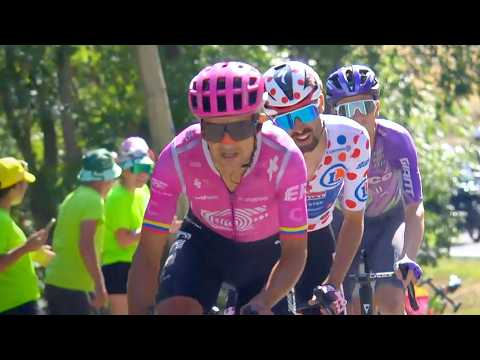
• Richard Carapaz Stares Down his Breakaway Opponents | Tour de France 2026 Stage 18
    Lanterne Rouge presents highlights of Tour de France 2026 Stage 18. Become a channel member ...
    0 Yorumlar 0 hisse senetleri 193 Views
  • INRNG.COM
    Tour de France Stage 19 Preview
    Alpe dHuez awaits, the classic climb but this time with a more gentle approach. Can UAE keep a lid on things so that Tadej Pogaar gets a prestige win for his palmars?Festival des Cannes: one of the enjoyable aspects of stage races is seeing multiple races happening at the same time. One saw Mads Pedersen going in the breakaway he managed to make moves all the way to the intermediate sprint in Corps after 129km to take a valuable 25 points.Early on Richard Carapaz and Valentin Paret-Peintre were in a different contest as they battled for the mountains points, the Frenchman picking off each sprint with a sprint that belied his waif-like build.Later a solid move got clear but Carapaz missed it. His EF team mates Alex Baudin and Ben Healy set about correcting this and helped tow a willing counter move across to the front.After Pedersen won the intermediate sprint Felix Engelhardt and Matteo Jorgenson floated away and then Tobias Halland Johannessen got across. Once theyd got a few metres things changed and you could see their backs hunched and elbows going in as they accelerated. Raul Garcia Pierna moved taking Mauro Schmid with him. This allowed Engelhardt to pull harder for his team mate Schmid, prising open the gap before he could do no more. Netcompany-Ineos had missed the move but while Thymen Arensman tried to chase Richard Carapaz darted past with a big counter-attack, taking Paret-Peintre with him. This left six clear with 45km to go and Ineos chasing.Coming to the finish Garcia Pierna had been dropped but got back and looked like the weakest of the six. At times they were spread across the road to Orcires-Merlette, nobody wanting to lead, looking at each other like poker players around a table trying to second-guess who held which cards and scrutinising rivals for the slightest tell in body language.Jorgenson looked the most likely to attack and was the first to move. He prompted a counter-attack from Richard Carapaz and Paret-Peintre dived on the Ecuadorians wheel. Carapaz went again and this time nobody could follow. Paret-Peintre cracked in finishing fourth missed on the points to take the polka-dot jersey for real rather than leasing it.Its a victory for a rider with an artistic and rebellious streak. He attacked on the Puy Mary in an attempt to slip the UAE yoke on Stage 10. And hes not done yet.Elsewhere Brandon McNulty abandoned the stage, another UAE rider to fall ill after Adam Yates and Tim Wellens was among those dropped early. Any team talk of Yatess illness being an isolated affair looked questionable. Tadej Pogaar seems fine but no rivals tried a move on the final climb to test. Also a final plotline in that UAE were spared some duties when the likes of Pinarello-Q36.5, Tudor and Total chased to protect the GC standings of Tom Pidcock, Yannis Voisard and Jordan Jegat.The Route: 128km and 3,500m of vertical gain. Its uphill from the start out of Gap on the Col Bayard. This roads often featured for arrivals in Gap as the climb to take before the white knuckle Rochette descent back into Gap. The Bayard is a big wide road.The Col du Noyer is not, a start amid fields and woodland and then a wild feel. Its 7.5km at 8.5% with the final 2km with 10% sections between the hairpins.The route then crosses back across the landscapes taken on the previous stage via the Route Napoleon.The Col dOrnon is a quiet backroad and a gentle climb. The descent is more remarkable, rarely steep either but with more hairpins and some moments where the road is cut into the cliff. Its technical, cyclings euphemism for a dangerous descent.The Finish: Alpe dHuez is a tough climb, over 13km at over 8% is hard by any measures. The start is the hardest part, the ramps have double-digit gradients. Its famous for the 21 hairpins and they count, a rider can pick their line through these bends to suit and allow someone with energy to spare to accelerate. The slope kicks up for the ramp that leads into the ski resort and from there after the slope eases. Theres a left turn onto the finish line on the Avenue du Rif Nel.The Contenders: having given Richard Carapaz (EF) three chainrings for the previous stage and writing that even if he won hed be tipped again, he is. Watching him race to the finish he didnt ease up when hell need plenty to be be able to go again today. Ben Healy helped set him up and isnt the same force as last year but has a chance too.Tadej Pogaar (UAE) will want the stage win but given several team mates are ill this poses questions above his teams ability to control the stage, and thats before we ponder if hes immune to this. So hes not the shoe-in he ought to have been for this stage.Netcompany-Ineos missed the winning move yesterday and later shut down the chase but does Thyman Arensman have anything to spare? Valentin Paret-Peintre (Soudal-Quickstep) faded on the previous stage but if he can recover this stage will be less intense for him, especially if he gets a colleague in the breakaway with him.Riders who fit the bill and were not riding as hard on the previous stage include Sepp Kuss and Davide Piganzoli (Visma-LAB), Ilan Van Wilder (Soudal-Quickstep), Harald Tejada (XDS-Astana) and Einer Rubio (Movistar).Finally Tom Pidcock (Pinarello-Q36.5) sits eighth overall but has still been making moves and he won the last time the race came to the Alpe in 2022.Carapaz, Arensman, Pogaar, VP-P, KussJorgenson, Rubio, Healy, Tejada, Piganzoli, PidcockWeather: sunny and 29C.TV: KM0 is at 2.15pm and the finish is forecast for 5.25pm CEST. The intermediate sprint at the foot of the Col dOrnon should be reached around 4.25pm and the climb to Alpe dHuez begins around 5.00pm.The post Tour de France Stage 19 Preview first appeared on The Inner Ring.
    0 Yorumlar 0 hisse senetleri 233 Views
  • WWW.CYCLINGWEEKLY.COM
    Betrayal, unbreakable records, and a four-second thriller: the greatest Alpe d'Huez ascents in Tour de France history
    For more than 70 years, Alpe d'Huez has been an icon of the Tour de France. Its 21 hairpins - cycling's most famous switchbacks - snake up from the valley, climbing relentlessly toward the ski resort that spills from the summit. On any normal day, the road is wide and the bends are sweeping. But when the Tour takes over and hundreds of thousands of fans pack the slopes, that open road shrinks into a deafening, claustrophobic, smoke-filled corridor. "You have to just pray that everyone's going to move out of your way," said Tom Pidcock after he soloed to victory on the climb in 2022. This year, in a curtain-closing double-header, the race will visit the summit twice: first via the traditional 21 hairpins on Friday's stage 19, and then from the east the following day, crossing the Col de Sarenne to finish on the final three bends. It is here that the yellow jersey will be decided, and another Tour legend could be written. Here are the stories of those who came before. The first: Fausto Coppi, 1952Italian legend Fausto Coppi en route to victory on the tenth stage of the Tour de France in 1952 (Image credit: Getty Images)Though the first Tour was in 1903, it wasn't until 4 July 1952 that the race hosted its first true mountain-top finish: a 266km stage from Lausanne to Alpe d'Huez. Until then, the ski resort at the summit had stood deserted in the summer months. The hoteliers, tired of the tourist drought, had a whip round and paid to welcome the Tour. The stage that day was hot and long. It took the riders more than eight hours to reach the foot of the climb, where, slumped over their steel frames and with spare inner tubes wrapped around their necks, they began hauling their bikes skywards. With 6km to go, the 1949 champion Fausto Coppi dropped Frenchman Jean Robic - "I knew he was no longer there when I couldn't hear him breathing anymore," Coppi later said - and soloed to an historic stage win. The victory earned Coppi the yellow jersey, which he would keep to win his second Tour title. The slow nature of the stage, however, failed to convince the organisers that mountain finishes were exciting, and the climb didn't feature again until 1976. The most surprising: Lucho Herrera, 1984Colombia's cyclist Luis "Lucho" Herrera celebrates as he crosses the finish line on July 16, 1984, the 17th stage between Grenoble and Alpe d'Huez (Image credit: Getty Images) Luis 'Lucho' Herrera wasn't supposed to win on Alpe d'Huez in 1984. A 23-year-old amateur cyclist and former plant delivery man from Colombia, he was making his Grand Tour debut with team Varta-Colombia, a national squad invited to make up the numbers. All eyes were on the yellow jersey battle between Laurent Fignon and Bernard Hinault that summer. On Alpe d'Huez, Herrera took advantage of his under-the-radar status to attack with around 10km to go. He rode at his own rhythm, and ended up holding off Fignon by 49 seconds. The victory was momentous: Herrera became South America's first Tour stage winner, and paved the way for a golden era of Colombian cycling. The following season, Varta-Colombia turned professional as Caf de Colombia, and Herrera went on to climb to greater heights, winning the King of the Mountains classifications in all three Grand Tours, and the overall at the Vuelta a Espaa in 1987. The fiercest: Bernard Hinault v Greg LeMond, 1986Greg LeMond (L), in yellow, and Bernard Hinault (R) climb Alpe d'Huez during the 18th stage of the 1986 Tour de France (Image credit: Getty Images)If the 1986 Tour is, as many believe, the race's greatest edition, then stage 18 to Alpe d'Huez - the duel between La Vie Claire team-mates Bernard Hinault and Greg LeMond - is perhaps its most dramatic single day. That year, defending champion Hinault had promised to ride in the service of LeMond. The Frenchman, however, appeared to have a change of heart when he wore yellow for five days, and began eyeing his sixth title. Then, on stage 17, he lost three minutes, and the yellow jersey, to LeMond. The scene the following day on Alpe d'Huez was one of bizarre tension. Having broken free as a duo, Hinault and LeMond rode through the hairpins shoulder-to-shoulder in what was supposed to depict team harmony, but instead laid bare the power struggle that had defined that edition of the Tour. Team orders came for LeMond to cede the stage win to Hinault, which he duly did, on the expectation Hinault would stop attacking him. But fighting talk followed. "This Tour is not finished," Hinault told reporters at the summit. "If we have a war, it'll be a fair war and the stronger one will win." That rider ended up being LeMond. Hinault retired six weeks later. The fastest: Marco Pantani, 1997Marco Pantani on his record-setting ascent on stage 13 of the 1997 Tour de France (Image credit: Getty Images / Mike Powell /Allsport)Still today, almost 30 years on, nobody has climbed Alpe d'Huez faster than Marco Pantani did in 1997. The full climb was measured in those days at 14.5km, which the Italian completed in 37 minutes and 35 seconds. Over the modern-day 13.8km route, his time was 36:55. Pantani went on to finish third overall that year, before winning the race the following year, his trademark bandana wrapped around his head. Of course, history tells us that 'The Pirate' was a troubled character; although he never tested positive for performance-enhancing drugs during his career, he excelled in an era when EPO plagued the peloton. His haematocrit level, the volume percentage of red blood cells in the blood, was so high that his veins were said to run with thick, red sludge. His resting heart rate was around 34bpm. Pantani had died by the time anyone got close to his Alpe d'Huez record, succumbing to a cocaine addiction in February 2004, aged just 34. That summer, Lance Armstrong attacked Alpe d'Huez in a mountain time trial at the Tour. He won the stage (later revoked), but fell a second short of Pantani's benchmark. The fastest time recorded since the introduction of the biological passport in 2008 belongs to Nairo Quintana, who climbed the Alpe in 39:22 during the 2015 Tour de France. The brightest: Geraint Thomas, 2018Geraint Thomas climbs Alpe d'Huez in yellow at the 2018 Tour de France, stage 12 (Image credit: Getty Images)In 32 appearances at the Tour, Alpe d'Huez has only ever seen one rider win on its slopes in the yellow jersey: Geraint Thomas. The Welshman began the 2018 edition as a lieutenant to the defending champion Chris Froome. But when Froome lost time on an early stage across the Roubaix cobbles, Team Sky gave Thomas the nod to see how far he could go. The answer, it turned out, was all the way. On stage 11, Thomas climbed to a stage win in La Rosire and took hold of the yellow jersey. Then came Alpe d'Huez: could he hold off Tom Dumoulin, Romain Bardet and his once leader Froome? Thomas and the GC group climbed as if attached by rope behind the pace set by 21-year-old Tour debutant Egan Bernal, who would win the race the following year. In the end, it came down to a shoot-out at the summit. Thomas launched first, slingshotted himself around the final bend, and won by two seconds. "Not a chance in hell did I think I was going to win today," he told the TV cameras post-race. "I just can't believe it. Alpe d'Huez, man." The youngest: Tom Pidcock, 2022Tom Pidcock passes through Dutch corner on L'Alpe d'Huez during the 2022 Tour de France (Image credit: Getty Images)It's funny, really, that the lasting image of Tom Pidcock's Tour debut wasn't his triumph on Alpe d'Huez, but his masterclass descent of the Col du Galibier from a few hours before. Still, such is the Olympic mountain bike champion's skillset that he is capable of stunning twice in one afternoon. The then-22-year-old must have sensed that day was one for the breakaway. With 125km to go, he tore down the Galibier like a swooping falcon to join Chris Froome's group up the road. Barely two kilometres into the bottom of the Alpe, he left his fellow escapees behind. All that remained was to navigate the mass of the crowds. "At times it just seemed like there was no road in front of me," he later told Cycling Weekly. "Then suddenly people would move and I could ride through." Prior to Pidcock's win, 23-year-old Lucho Herrera had gone 38 years as the youngest rider to win on Alpe d'Huez. That accolade now belongs to the Briton. The closest: Kasia Niewiadoma, 2024(L-R) Evita Muzic and Kasia Niewiadoma in the chase group during the 2024 Tour de France Femmes (Image credit: Getty Images)Kasia Niewiadoma didn't win the stage on Alpe d'Huez at the 2024 Tour de France Femmes avec Zwift. And yet, it's her name that became synonymous with the climb that summer. The Polish rider led the reigning champion Demi Vollering by 75 seconds going into the final day. That gap, however, soon began to fall on the road, as Vollering broke clear on the Col du Glandon and barrelled towards Alpe d'Huez with the breakaway. Faltering behind, Niewiadoma chased as hard as she could. Could she manage to hold on? The clock began to tick the moment Vollering lurched beyond Pauliena Rooijakkers to win the stage. Vollering then sat on the ground and watched. Thirty seconds passed. A minute. Until, with only four seconds to spare, Niewiadoma came sprinting across the line and collapsed. It is, still today, the smallest winning margin in the history of both the men's and women's Tours. Had Niewiadoma eased off for only a few pedal strokes, she would have lost her yellow jersey. "It's so mind-blowing," she said afterwards. "I hated everything [up until] arriving at the finish line and learning that I won the Tour de France - it's insane." ALPE D'HUEZ IN NUMBERS (Image credit: ASO)Distance: 13.8km Altitude: 1,850m Elevation gain: 1,120m Average gradient: 8.1% Max gradient: 13% Hairpins: 21 Tour appearances: 32 (34 after this year) Fastest ascent: 37:35 (Marco Pantani, 1997, on the 14.5km route) This feature was originally published in the 23 July 2026 print edition of Cycling Weekly magazine available to buy on the newsstand every Thursday (UK only). Digital versions are available on Apple News and Readly. Subscriptions through Magazines Direct.
    0 Yorumlar 0 hisse senetleri 106 Views
  • CYCLINGUPTODATE.COM
    "We don't know if we are ready for this form of doping" - Belgian expert suggests ITA might've suspected gene manipulation
    The topic of doping has returned to the cycling community after anti-doping authorities paid a late night visit to Tadej Pogacar and Jonas Vingegaard ahead of key stage 15 of the 2026 Tour de France. While Pogacar took the stage in a leisurely pace, for his rival the consequences of interrupted slee...
    0 Yorumlar 0 hisse senetleri 116 Views
  • WWW.CYCLINGWEEKLY.COM
    'I think the dream is dead this year' Lewis Askey rode too well at the Tour de France to be lanterne rouge
    As I beckoned Lewis Askey over to talk to me ahead of stage 17 of the Tour de France in Chambry, he already knew what I wanted to talk to him about.The NSN Cycling rider has had a solid Tour, the second time he has been here, now part of the team behind Biniam Girmay's challenge in sprints and the green jersey competition, but that's not what I was interested in. When we spoke on Wednesday lunchtime, Askey sat 163rd overall, 4:38:18 behind race leader Tadej Pogaar (UAE Team Emirates-XRG), and only 21 seconds ahead of the man in dead last, Kamil Gradek (Bahrain Victorious). It meant he was almost lanterne rouge, the mythical position of finishing last at the Tour. He cut a relaxed figure in Chambry, revelling in his status as the second-slowest man at the race. It reassured me that he was taking the battle for last place seriously, potentially even that it was something he was aiming for, should the stars align. There was no sigh, or resignation at being asked about being four hours behind the yellow jersey."I'm made for going fast over short periods of time, not for doing five or six hours going up a hill," the 25-year-old explained to Cycling Weekly. "Because of that, my goal is to use the least energy possible. If I'm not there to do a job or to go for the win, I'm going to take it as easy as I can, and it's easier if I'm in a group, because if you drop off earlier you end up struggling and using more energy. "Any of the climbs we've been OK for the time cut, then I go as easy as I can all the way to the line.""I can't play with it," he said of his status on the general classification. "I would have played with it a little bit more, but the days to come will be a fight all the way to the line for the time cut. I don't think there will be any playing now."Finishing last is something that four British riders have ever achieved: Tony Hoar, John Clarey, Luke Rowe and Mark Cavendish.(Image credit: Getty Images)Askey has been working at this race for Girmay, his team's sprinter, who has finished sixth, third, second, sixth and fourth in the five bunch sprints at the Tour, as well as being a presence in the battle for the green jersey. Being lanterne rouge does not imply being the worst rider in the race, far from it, perhaps instead just showing a mastery of energy levels and timing.As a result, Askey has put in a lot of work for intermediate sprints and for bunch finishes, and has concentrated less on the hillier and mountainous days, hence the loss of time. That does not mean he has been putting in any less effort, though."I've had one day, maybe two where I've been able to go relatively easy to the line, maybe two," Askey explains. "The day before the rest day, it was full gas at the start to be in the group that ended up becoming the peloton, and because we started the final two climbs with them, it meant the time cut was quite long. We were at zero minutes back when we started the climb, so it allowed us to go at training pace up the climb. All the other climbs, I'm pretty much close to my limit, I couldn't go very much faster if I had to."On the Markstein day, we had the sprint just before the first climb, every climb we rode on our limit. Every 5km we were chopping off doing 60kph, trying to make it, and we made it there with three minutes to spare. It's not easy."Asked if he'd like to finish dead last, Askey said: "Why not? It's cool, no? It's better to be properly last rather than second last. You're talking about it, aren't you? It has a bit of history, so it's a nice thing to do. "I wouldn't go out of my way specifically, but now I'm thinking I should have lost a bit of time the other day when I went easy to the line."(Image credit: Getty Images)Just over four hours later, it turned out that finishing last was not the priority for the man from Staffordshire. On a chaotic stage 17, Askey worked hard to get into the day's break, then was part of the action as it forced its way to the front of the race, a key protagonist, and he ended up finishing fourth. It was his best result not just at the Tour, but at any Grand Tour, and his second-best WorldTour finish. It was the kind of performance Askey is capable of, but it showed a real lack of commitment to the lanterne rouge goal. It disappointed me, too. "It was a good day, it was nice, the first opportunity I've been given at this Tour, so it was nice to get something out of it," he said before stage 18. "I would have like to come second in that sprint instead of fourth, but I think I rode a pretty good race. I didn't have any regrets in that final. I think I did pretty well to get there, to be honest."What of the great fight to finish last? "I think the dream is dead this year, unfortunately. I did actually think about that, 40km to go we jumped across, we were this big group, I saw the time gap out and I was like ah, I think that's the lanterne rouge gone now. I'll go for it again, there's still plenty of years to go."My dream too might be dead, but such is the wheel of fortune at the Tour de France. Stage 18 was back to business for Askey, as he finished 160th, 34:49 behind stage winner Richard Carapaz, but it's probably too little, too late he's now up to the dizzying heights of 157th overall, 8:10 ahead of the new lanterne rouge, Cees Bol (Decathlon CMA CGM). I suppose if it's not now, there's always next season.You can read Lewis Askey's thoughts on the Tour de France in Cycling Weekly. Subscribe now.
    0 Yorumlar 0 hisse senetleri 116 Views
  • shes dropping off a ROOF?!
    0 Yorumlar 0 hisse senetleri 158 Views
  • WWW.BIKERADAR.COM
    New Kali Kru brings ice hockey tech to MTB helmets with its 360-degree titanium chin bar
    The new Kali Protectives Kru takes its inspiration from ice hockey helmets, promising downhill-MTB level protection with the lightweight breathable comfort of a trail helmet.Kali says the new Kru helmet offers full-face protection with the ventilation and visibility riders need to climb comfortably and descend confidently on the same ride.Brad Waldron, Kali founder and lead engineer, says the Kru is an idea 10 years in the making. While watching his kids playing hockey, Waldron started looking at the helmets and their titanium face masks. He explains: "It looked non-intrusive. I couldnt help but wonder, why don't we build a full-face bike helmet like that?"Unlike a hockey helmet, however, the chin bar isnt attached to the helmet post-moulding and construction. In fact, its a continuous titanium structure within the helmet itself (much like a skeleton). Kali says this full 360-degree construction method preserves the true strength of the design with no weak elements such as joins or bolted sections.The challenge posed by this design was the precision needed from the titanium skeleton for it to be integrated safely within the helmet's moulding process to ensure both elements worked in conjunction with each other. Kali claims the Kru is designed for the needs of modern mountain biking. Kali Protectives Waldon believes the time is right for an advanced helmet such as this because of the way modern mountain bikers ride. He says: "Our bikes allow us to ride harder and more aggressively than ever before. Our helmets need to keep up. What you need to know about the Kali Kru Unique 360 titanium chin bar Available sizes: S/M, L/XL Weight: 650g (size S/M), 680g (size L/XL) Certifications: CPSC, EN 1078, ASTM F1952 Available colours: Solid Black, Solid White According to Waldon, riders are looking for downhill-level protection, but want the lightness and airflow of non-downhill designs. He says: The titanium chin bar almost disappears when you're riding. Even climbing, the airflow is incredible. You forget it's there, and that lets you focus on the ride." The Kru was inspired by ice hockey helmets. Kali Protectives The Kru is claimed to weigh in at 680g for an L/XL or 650g (size S/M), which is heavier than three-quarter helmets such as the latest Troy Lee Designs Stage Stunt at 571g (M/L), although around the same as the similarly pitched Fox Dropframe Pros 654g (M).However, it's a lot lighter than downhill-specific helmets such as Bells Full-10 at 1,070g for a medium.The Kru meets full ASTM Downhill certification requirements and Kali Protectives claims to exceed them with additional in-house internal impact testing beyond current safety requirements.That means higher impact speeds with larger coverage areas than standard CPSC or EN 1078 ratings. It also covers retention systems and chin bars on full-face helmets. The Kru meets CPSC, EN 1078 and ASTM F1952 Downhill certification standards. Kali Protectives The Kru is priced at 299.99 / $450, meaning it's priced comparably against the best enduro helmets and cheaper than many dedicated downhill lids.Could it be the ideal solution for riders looking for extra protection without the bulk traditional full-face designs bring?
    0 Yorumlar 0 hisse senetleri 132 Views
  • ROAD.CC
    Why Alpe dHuez is the Tour de Frances most iconic climb maybe even if it isnt the best
    Stages of the 2026 Tour de France finish on Alpe dHuez twice in two days, underlining the mountain's important place in cycling folklore, but what makes this famous climb so special when there are bigger, tougher and more beautiful roads in the Alps?
    0 Yorumlar 0 hisse senetleri 107 Views
  • CYCLINGUPTODATE.COM
    Tadej Pogacar risks losing the Tour de France to an invisible enemy - This is how UAE is tackling it
    The Tour de France's brutality is taking a toll on its riders and UAE Team Emirates - XRG, who have dominated from start to finish, are perhaps having their roughest days. Ahead of the race's queen stage on Saturday, the team has lost Brandon McNulty whilst at least two other riders have come down w...
    0 Yorumlar 0 hisse senetleri 110 Views
  • Toughest rider you have competed against? The Tour de France class of '26 have their say!
    TNT Sports marks a new era in sports broadcasting in the UK and Republic of Ireland across TV, streaming, digital and social ...
    0 Yorumlar 0 hisse senetleri 124 Views